4 min read
Customer enquiry management for boutiques
The same 'is this available?' asked eleven times a day. How an enquiry inbox with statuses — and a drafted WhatsApp reply — answers every one.
Picture a boutique owner opening her phone after a two-hour fabric run. Eleven notifications. "Is the mustard suit still available?" "Price of the second saree in yesterday's post?" "Do you have this in XL?" "Is this available?" — that one four times, about three different pieces, one of which sold last week.
She answers the first few in the auto-rickshaw. Two more over dinner. The last three she means to answer, and by morning they've slipped below newer messages, unanswered forever. Each one was a customer with money in hand, asking to be sold to. This is the strangest leak in boutique retail: not lost customers — lost answers.
Every enquiry is a hot lead with a timer
Marketing people would pay real money for what an enquiry is: a person who has seen a specific product and taken the effort to ask about it. But enquiries decay fast. Answered within the hour, they convert remarkably often; answered in two days, the moment has passed — she's bought elsewhere, or the impulse faded with the scroll. That's the core injustice of doing enquiries from a chat list: the oldest enquiries, the ones closest to dying, are the ones buried deepest.
An inbox flips that. Every question — from the shop page, about a specific product or just "do you do bridal work?" — lands in one list, oldest and still-open at the top, each one carrying which piece it's about.
Status is the difference between an inbox and a pile
A list of questions is only half the fix. The other half is knowing where each one stands, and — as with orders — three states are plenty:
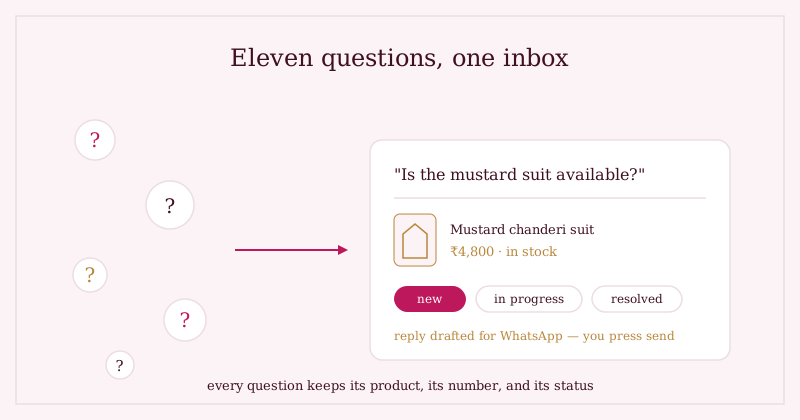
- New — unanswered. This number should be zero by closing time; now you can actually see the number.
- In progress — you've replied, the conversation is live. "Checking with the tailor about the sleeve" lives here.
- Resolved — answered, and either converted into an order or gracefully closed.
The daily ritual takes five minutes: clear the new, nudge the stale, mark the finished. Compare that with re-scrolling thirty chats hoping nothing important is under the family group.
The reply should be half-written before you arrive
Look at what answering "is this available?" actually involves: find the product they mean, check its price and status, switch to WhatsApp, find the person, type the answer. Five steps for a one-line reply — multiplied by eleven a day.
When the enquiry arrives attached to the product, most of those steps dissolve. The piece, its price and its availability are already on the enquiry card; one tap opens WhatsApp with a reply drafted from the facts. You edit the tone, add the warmth — that part should always be yours — and press send.
The goal isn't to answer customers automatically. It's to make the personal answer so cheap to give that no enquiry ever dies of neglect.
This matters double if Instagram drives your discovery — a "price?" comment that goes unanswered for a day is exactly how saree sellers lose orders on Instagram.
Where we're taking this next: letting common factual questions — price, sizes, availability — be answered from product data even faster, so your typing is saved for the conversations that need a human.
Where Studio OS fits
Studio OS turns enquiries from a memory test into a checklist:
- General and product enquiries from your shop page land in one dashboard inbox — with the product attached, so you never have to guess "which saree does she mean?"
- Every enquiry moves through new → in progress → resolved, so "did anyone reply to her?" has an answer at a glance.
- One tap opens WhatsApp with the reply already drafted from the enquiry and the product's details. You edit, you press send — Studio OS never messages a customer itself.
- Because enquiries carry a phone number, each one quietly builds your customer book too.
Send yourself a test question from the demo shop and watch where it lands — or start with Studio OS and let "is this available?" finally have a system.